 VI
VI EN
EN
Scientific and practical solutions for managing stem cracking and gummosis in durian, helping control the disease effectively and sustainably.
H1: Scientific and Practical Management Solutions for Durian Stem Cracking and Gummosis
1. Quick Summary
Stem cracking and gummosis in durian is one of the most dangerous diseases today, which can cause tree death if not treated promptly. The main causal agents are fungi belonging to the genus Phytophthora, especially Phytophthora palmivora, which can survive for long periods in soil and spread rapidly through rainwater or irrigation (Guest, 2007; Drenth & Guest, 2004). Under production conditions in Vietnam, the disease often outbreaks during the rainy season when soil and air humidity increase, creating favorable conditions for zoospores to move and infect plant tissues (Zentmyer, 1980). Effective management solutions should not rely solely on chemical control but must integrate multiple measures such as water management, soil improvement, and enhancing plant resistance following the IPM approach (FAO, 2011).
2. Analysis
People searching for “durian stem cracking and gummosis” are usually growers who have observed dark brown sap exudation on the trunk or elongated cracks on the bark—typical symptoms caused by Phytophthora (Drenth & Guest, 2004). Their main goal is to find quick solutions to save trees and limit disease spread within the orchard. According to research on user behavior in digital agriculture, farmers tend to prioritize practical, easy-to-apply, and cost-effective solutions over purely theoretical approaches (World Bank, 2019). Therefore, the content should focus on disease mechanisms combined with practical field-level solutions.
3. What is durian stem cracking and gummosis?
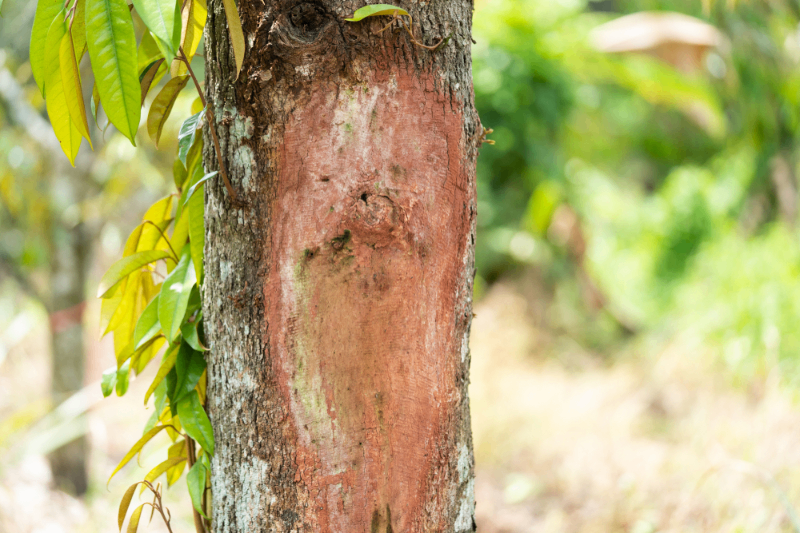
Stem cracking and gummosis in durian is a disease caused by oomycete fungi of the genus Phytophthora, with Phytophthora palmivora considered the main pathogen affecting many tropical fruit crops, including durian (Drenth & Guest, 2004). This pathogen has unique biological characteristics, including the ability to produce motile zoospores with flagella, allowing them to move in water and easily infect plant tissues through mechanical wounds or weak bark areas (Erwin & Ribeiro, 1996). Studies in Southeast Asia show that Phytophthora spore density in soil can increase significantly after heavy rainfall, thereby increasing the risk of infection in durian trees (Guest, 2007).
4. Symptoms and damage mechanism
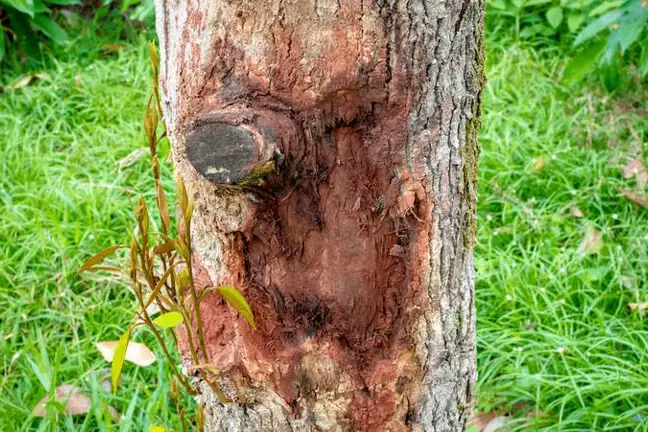
Typical symptoms include longitudinal cracks on the trunk or main branches, accompanied by dark brown gum exudation. This is the result of tissue destruction in the phloem and cambium layers caused by the pathogen (Zentmyer, 1980). When the pathogen infects, it secretes enzymes that break down cell walls, disrupting tissue structure and causing leakage of cell fluids, leading to gummosis (Erwin & Ribeiro, 1996). According to plant physiology studies, tissue damage disrupts water and nutrient transport, reducing plant growth and potentially causing tree death if lesions girdle the trunk (Agrios, 2005). Under high humidity conditions, the disease can spread rapidly from the trunk to roots or branches, causing severe damage to the entire tree (Drenth & Guest, 2004).
5. Causes and conditions for disease development
Stem cracking and gummosis develop strongly when multiple environmental factors combine, with the most critical being high soil moisture and poor drainage, which create ideal conditions for Phytophthora zoospores to develop and move (Guest, 2007). Epidemiological studies show that orchards with compacted soil layers or poor drainage have significantly higher disease incidence than well-managed orchards (FAO, 2011). In addition, mechanical wounds on the trunk caused by insects or cultivation practices provide entry points for the pathogen (Agrios, 2005). Nutrient imbalance, particularly excess nitrogen and calcium deficiency, also weakens plant tissues and increases susceptibility to infection (Marschner, 2012).
6. Integrated management solutions for stem cracking and gummosis
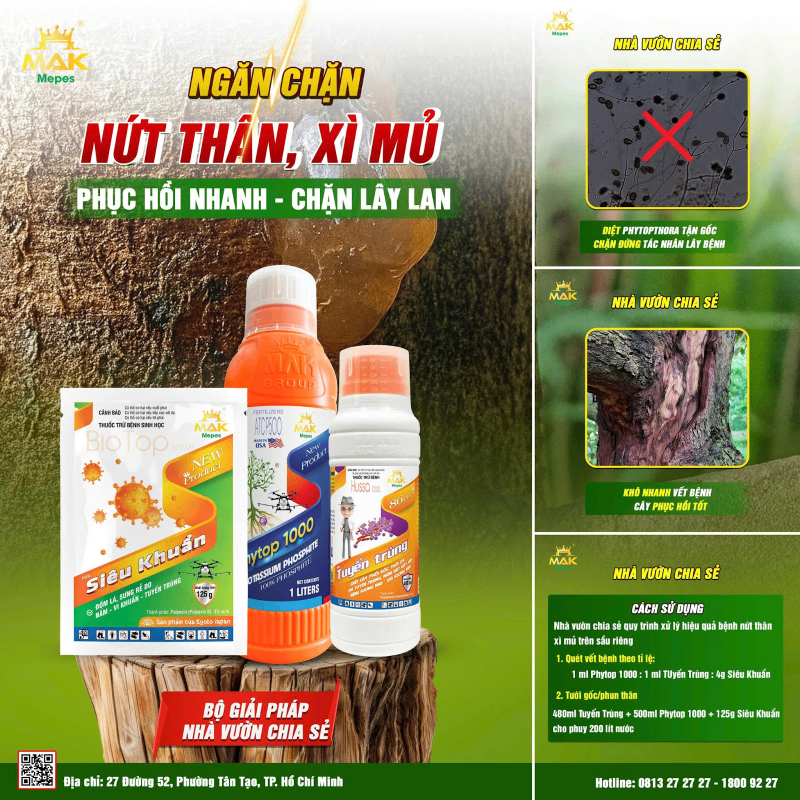
Effective disease management requires an integrated approach (IPM), in which improving cultivation conditions plays a foundational role. This includes designing effective drainage systems, avoiding prolonged waterlogging, and improving soil structure to increase aeration (FAO, 2011). In parallel, biological products containing Trichoderma spp. have been proven to suppress Phytophthora through competition and parasitism mechanisms (Harman et al., 2004). In severe cases, chemical control using active ingredients such as Metalaxyl, Fosetyl-Al, or Phosphonates can effectively control the disease when applied at the correct timing and dosage (Drenth & Guest, 2004). Additionally, directly applying chemicals onto cleaned lesions after removing infected tissue is a practical method successfully used by many farmers.
7. Practical disease management process in production
In practice, when infected trees are detected, the diseased bark should be carefully scraped off until healthy tissue is exposed, followed by treatment with appropriate fungicides and direct application onto the wound surface to prevent further spread (Guest, 2007). Next, soil conditions should be improved by adding organic matter and beneficial microorganisms to restore root health and enhance plant resistance (Harman et al., 2004). Regular monitoring and early treatment of new lesions are critical to minimizing damage, as epidemiological studies indicate that Phytophthora diseases spread rapidly under favorable conditions if not promptly controlled (FAO, 2011).
8. Conclusion
Durian stem cracking and gummosis is a complex disease with a damage mechanism closely linked to environmental conditions and plant physiology. Therefore, effective management must be based on a combination of scientific knowledge and practical experience, rather than relying solely on chemical control (Agrios, 2005). When integrated management measures are properly applied, growers can control the disease at a level of 70–90% and maintain stable yields in the long term (FAO, 2011).
9. Contact
For more information about Siêu Khuẩn, Phytop1000, tuyến trùng , and other MEPES products, or for technical consultation on crop care and protection, customers can visit: https://www.mepes.vn/ or contact directly via hotline 1800 9227 – 0813 27 27 27 for the best support.