 VI
VI EN
EN
Durian Stem Cracking and Gummosis – Causes, Symptoms, and Effective Control
Learn about stem cracking (gummosis) in durian: Phytophthora as the causal agent, gummosis symptoms, conditions for disease development, and IPM strategies to protect orchards.
1. General Introduction to Durian Stem Cracking and Gummosis
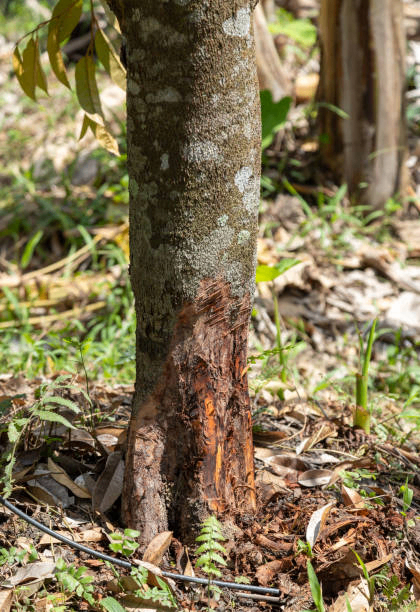
Stem cracking and gummosis in durian is one of the most serious diseases, occurring in many tropical durian-growing regions. The disease causes damage to the root collar, trunk, and branches, and can lead to leaf drop, root rot, and sap exudation (gummosis), affecting yield and tree longevity.
Many technical reports and studies in Southeast Asia identify Phytophthora palmivora (an oomycete, or water mold) as the main causal agent of gummosis in durian.
2. Causal Agent of Stem Cracking and Gummosis in Durian
- Main pathogen:Phytophthora palmivora (oomycete). Many epidemiological studies and surveys in Asia confirm that P. palmivora is the primary cause of stem cracking and fruit rot in durian.
- Key biological characteristics: Phytophthora is an oomycete (not a true fungus) capable of producing biflagellate zoospores that move in water. Its spores can persist in soil, water, and plant debris; it infects through wounds or weak tissues, causing tissue necrosis and lesions accompanied by sap exudation (gummosis).
3. Conditions for Disease Development in Durian Stem Cracking and Gummosis
- Rainy season / high humidity / waterlogging: spores move through water (rain, irrigation, runoff), so rainy conditions or poorly drained land greatly increase risk.
- Poorly drained soil, low soil pH, degraded soil, and dense canopies create favorable conditions for disease outbreaks.
- Mechanical injuries (cuts, insect damage, or machinery wounds) serve as entry points for infection.
4. Symptoms of Durian Stem Cracking and Gummosis
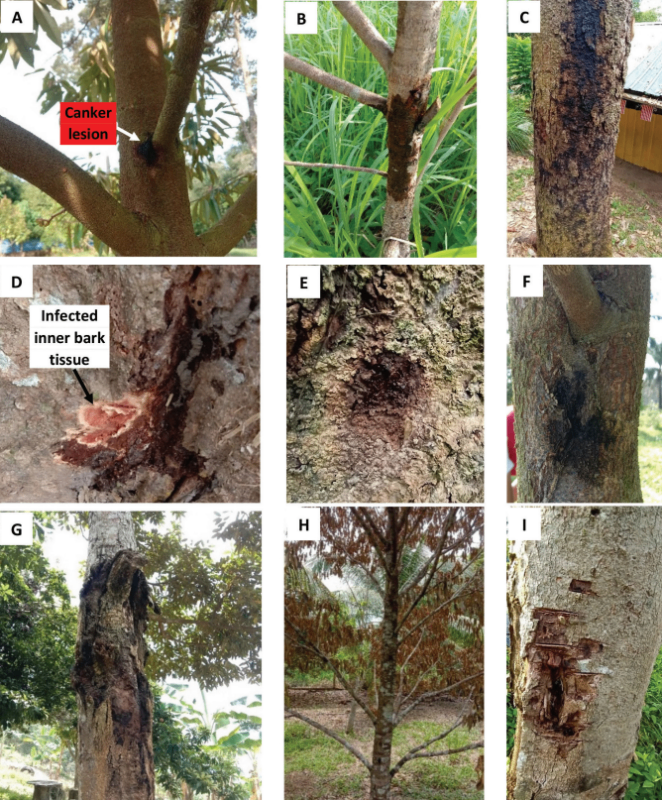
The following symptoms help farmers detect early and distinguish Phytophthora-induced gummosis from other diseases.
- Early stage: water-soaked, wet lesions at the trunk base or branching points; bark becomes darkened.
- Gummosis: when cutting into lesions, the tissue is soft and exudes sap—this is a typical sign of Phytophthora-induced stem cracking and gummosis.
- Stem cracking: lesions may expand, causing bark cracking, sunken areas, often occurring near the root collar or branch junctions; sometimes a necrotic ring around the trunk can be observed.
- Associated symptoms: leaf drop, yellowing, stunted growth; if roots are infected, root rot occurs and the tree weakens rapidly. Fruits may rot if infected at the peel.
5. Impact (Economic & Biological) of the Disease
- Causes stunted growth, reduced yield, and poor fruit quality.
- Severe trunk damage can kill the tree or make it unproductive long-term.
- Increases management costs (chemicals, labor, sanitation). Epidemiological reports in many countries show that Phytophthora is a major cause of root rot, stem rot, and fruit rot, leading to significant losses in durian orchards.
6. Integrated Disease Management (IPM) — Practical and Science-Based
Principle: prevention + environmental management + biological + chemical control; early intervention reduces major losses.
6.1 Cultural Practices
- Improve drainage and soil structure: raised beds, mounding, drainage ditches to prevent waterlogging around the base. Phytophthora spreads rapidly in waterlogged conditions.
- Open canopy and pruning: reduce humidity and dew retention.
- Use healthy planting materials; treat seedlings before planting; ensure disease-free sources.
- Minimize mechanical injuries and manage insects that create wounds (entry points for pathogens).
6.2 Biological / Beneficial Microorganisms
- Use antagonistic microbes: recent studies show some strains of Bacillus velezensis and Trichoderma can suppress Phytophthora in durian—applicable as soil or root treatments (e.g., 2025 study on Bacillus velezensis SM1).
- Apply organic fertilizers to improve soil health and microbial diversity, reducing favorable conditions for Phytophthora.
6.3 Mechanical / Physical Measures
- Remove and destroy infected tissues (cut diseased branches or scrape bark to healthy tissue, burn or bury deeply); disinfect tools after use.
- Protect wounds: after removing infected tissue, disinfect and apply protective treatment according to technical guidelines. Many practices recommend applying protective paste or oil-based sealants combined with plant protection products to prevent reinfection.
6.4 Chemical Control
- Important note: Always check locally registered products, follow dosage and pre-harvest intervals; rotate modes of action to prevent resistance.
- Systemic products for Phytophthora: active ingredients such as metalaxyl / mefenoxam (effective against Phytophthora), phosphite / fosetyl-Al (phosphorous acid/phosphonate) help control oomycetes and enhance plant resistance. Many studies recommend phosphite for Phytophthora diseases.
- Protective contact fungicides: copper or mixtures (e.g., mancozeb) used for preventive spraying.
- Soil drenching / trunk injection / wound application: some local techniques involve applying or injecting chemicals into the trunk to treat gummosis lesions. Technical guidelines recommend combining localized treatment with sanitation and pruning.
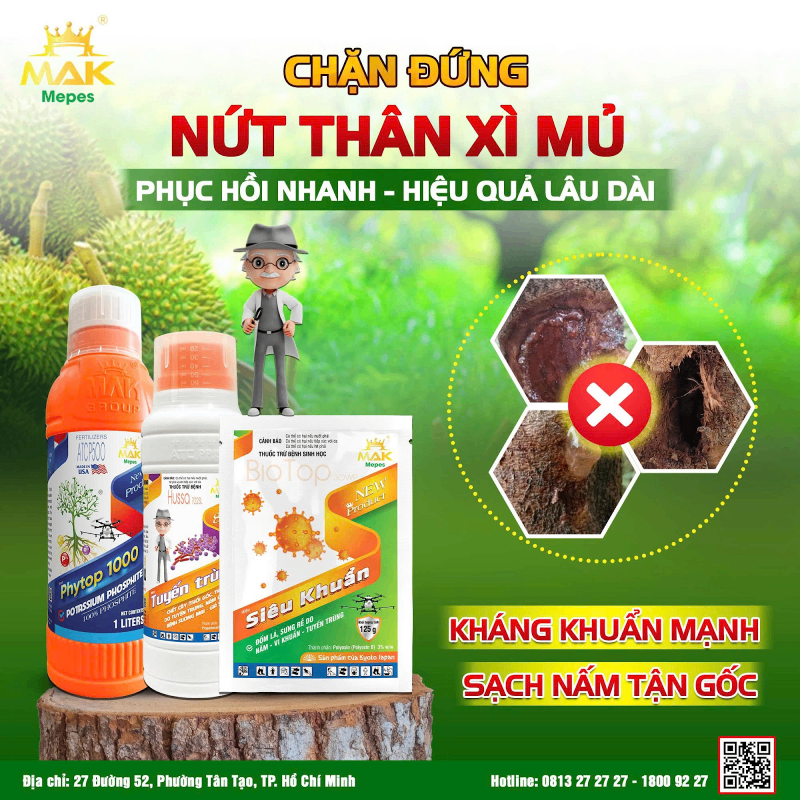
Many farmers share that using the product combination Phytop1000 + Tuyến trùng + Siêu khuẩn for soil drenching and applying onto cleaned lesions effectively manages stem cracking and gummosis. Lesions dry quickly within 36–48 hours, and regular preventive use significantly reduces recurrence.
7. Cropping Schedule and Response Strategy
- Pre-rainy season prevention: apply protective fungicides (copper / mancozeb) before the rainy season; check drainage systems.
- Early detection: inspect trunk base, root collar, and branch junctions after rain; if wet lesions or spots appear → intervene immediately: remove infected tissue, disinfect, and apply systemic/phosphite treatments.
- Rotate chemicals: alternate systemic and contact fungicides; vary modes of action between applications.
8. Recommendations & Notes for Farmers
- Prevention is better than cure: focus on drainage, clean planting material, and canopy management; avoid water accumulation around the base.
- Treat wounds promptly: all cuts or injuries must be disinfected and protected immediately.
- Use biological solutions when possible: combine Bacillus and Trichoderma to reduce chemical use and improve soil health; recent studies show Bacillus velezensis is promising for durian Phytophthora.
- Chemical safety: follow labels, use protective equipment, and protect the environment; do not use unregistered products for durian in your area.
9. Conclusion
- Main cause: Phytophthora palmivora is the common cause of stem cracking and gummosis in durian across many Southeast Asian countries.
- Conditions: disease outbreaks are strong during the rainy season, in waterlogged soils, dense canopies, and where wounds are present.
- Effective management: combine improved drainage and cultivation practices, use of antagonistic microbes, orchard sanitation, and application of systemic/translaminar fungicides, phosphite / fosetyl-aluminium / copper according to label instructions, with rotation of modes of action.
10. Contact Information
For more information about PHYTOP1000, TUYẾN TRÙNG, SIÊU KHUẨN and other MEPES products, or for technical consultation on crop care and protection, customers can visit:https://www.mepes.vn/ or contact directly via hotline 1800 9227 – 0813 27 27 27 for the best support.
11. References
- Sivapalan A. (1997). Patch Canker of Durio zibethinus Caused by Phytophthora — báo cáo dịch tễ.
- Nghiên cứu: Phytophthora palmivora as a Causal Pathogen of Stem Canker and Fruit Rot of Durio zibethinus in China (ResearchGate).
- PlantwisePlus Knowledge Bank — Phytophthora palmivora; Root rot, stem rot, fruit rot.
- Bài kỹ thuật/khuyến cáo nông nghiệp (VN): nhiều bài viết kỹ thuật tổng hợp về nứt thân xì mủ trên sầu riêng (ví dụ vietthanghanoi, funo, tanixa).
- Nghiên cứu 2025: Bacillus velezensis SM1: A Promising Biocontrol Solution (MDPI) — đề cập tiềm năng sinh học chống Phytophthora trên durian.